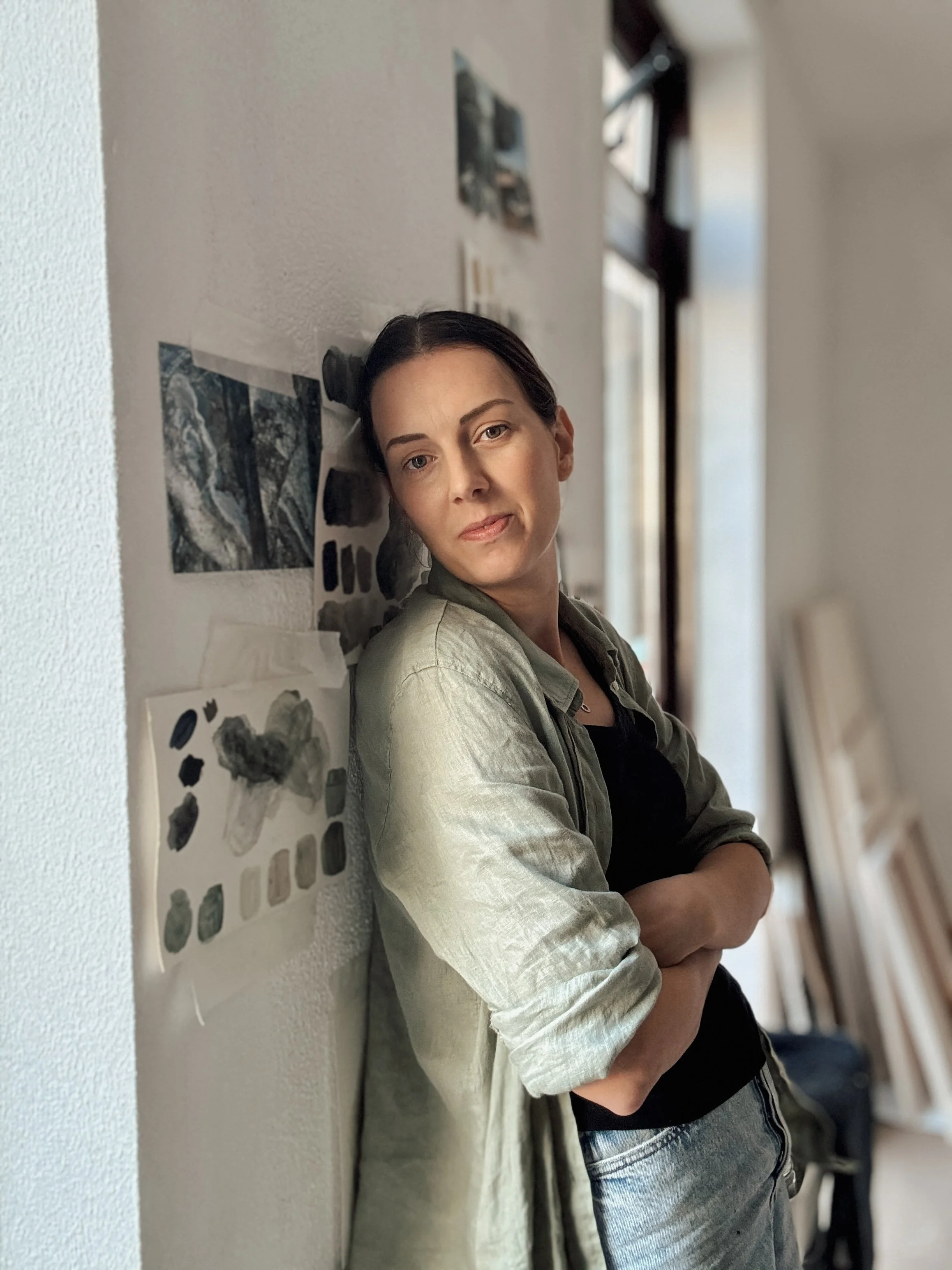
Why I paint abstract
Abstract art has always felt like a form of conversation to me.
Not a loud one.
Not a descriptive one.
But something more intuitive — something felt before it is understood.
I don’t see abstraction as the absence of subject.
I see it as the presence of emotion.
When I paint, I am not trying to replicate what a place looks like. A photograph can do that with precision. What I am drawn to is the atmosphere of a place — the subtle shift in air, the grounded sensation in the body, the way light rests on a surface.
That is what I try to carry onto canvas.
Why I Choose Abstraction
If I painted a specific landscape, you would see my memory.
When I paint a feeling, you are invited to meet it with your own.
This is why abstraction matters to me. It creates space for interpretation. It does not dictate meaning; it allows meaning to emerge.
The collector becomes part of the work. Their history, their associations, their emotional landscape — all of it enters the conversation.
The painting is no longer only mine. It becomes shared.
The importance of Presence
I am not interested in creating work that demands attention through intensity.
I am interested in creating work that holds a space.
Art that anchors a room rather than overwhelms it.
Art that draws you closer instead of pushing outward.
Art that allows you to reconnect with something steady within yourself.
In a world driven by speed and constant stimulation, I believe there is strength in restraint.
A Language Without Words
Abstract art does not tell you what you are looking at.
It offers you a field of experience.
And within that field, something personal unfolds.
Perhaps it reminds you of a childhood memory.
Perhaps it evokes a landscape you once loved.
Perhaps it simply gives you a moment of stillness in your day.
That is the power of abstraction for me.
It is not about shapes or color alone.
It is about carrying the feeling of a place — and allowing it to live again in someone else’s home.